In India, taking care of our health often takes a backseat until a problem becomes completely unmanageable. We regularly get our eyes checked, visit the dentist when a tooth aches, and monitor our blood sugar levels meticulously. Yet, when it comes to our ears, we tend to adopt a dangerous “we will adjust somehow” attitude.
Hearing loss creeps up silently. It starts with asking family members to repeat themselves during a lively dinner conversation, turning up the television volume just a notch higher, or missing the gentle chirp of birds in the morning. Despite the discomfort, millions of individuals delay seeking professional help. Why? Because the ecosystem surrounding hearing care is cluttered with deep-rooted misconceptions, social stigma, and outdated notions.
Most of these hesitations stem from stories told decades ago when hearing technology was primitive. If you or a loved one is standing on the fence about visiting a professional hearing aid center, it is time to separate fact from fiction.
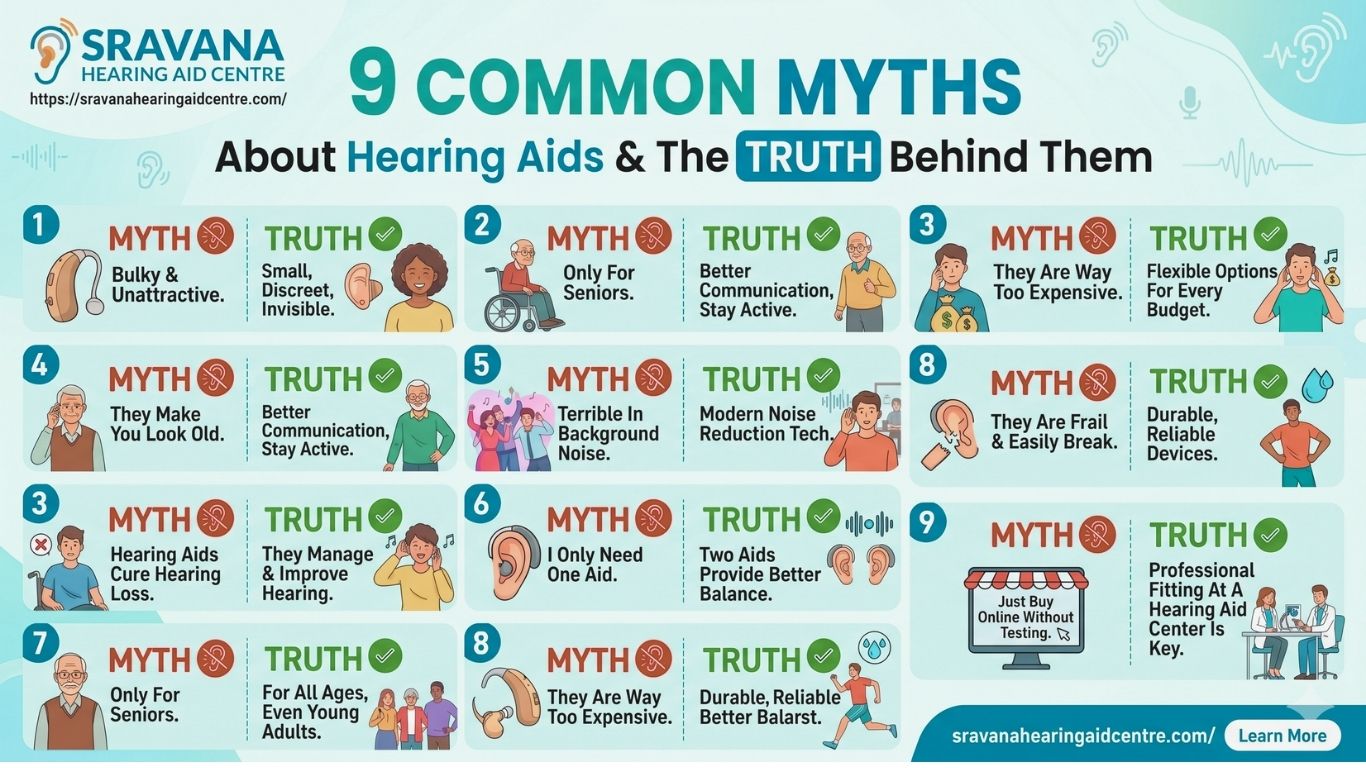
Let us debunk the 9 most common myths about modern hearing solutions and uncover the life-changing realities behind them.
Myth 1: “Hearing aids are only meant for the elderly.”
The Deep-Rooted Stigma
For generations, hearing aids have been unfairly branded as a definitive sign of old age. Many people believe that until you cross your late 60s or 70s, your ears should not need mechanical assistance. This social stigma forces younger adults to suffer in silence, avoiding family gatherings or professional meetings out of pure embarrassment.
The Modern Reality
The reality of the modern era is vastly different. Hearing impairment does not look at your birth certificate. Today, young professionals, college students, and even teenagers are walking into our hearing aid center with significant auditory challenges.
The primary culprit? Extended exposure to high-decibel noise. Our modern lifestyles involve commuting through chaotic, honking traffic, working in high-density corporate offices, and listening to music or podcasts via in-ear headphones at dangerous volumes for hours on end.
According to data from global health organizations, nearly 1.1 billion young adults worldwide are at risk of permanent hearing loss purely due to unsafe listening habits. Addressing a hearing issue in your 30s or 40s is not a sign of aging; it is a smart, proactive step toward preserving your career, relationships, and daily productivity.
Myth 2: “They are big, ugly, and look like massive plastic pieces behind the ear.”
The Vintage Image
When most people imagine a hearing aid, their mind immediately flashes back to the mid-20th century: a large, flesh-coloured plastic banana clumsily hooked over a grandparent’s ear, constantly slipping out and looking incredibly conspicuous.
The Modern Reality
If you haven’t stepped inside a modern hearing aid center recently, you are in for a massive surprise. Thanks to rapid advancements in micro-engineering, modern hearing devices have undergone a radical transformation. They are no longer just medical appliances; they are sophisticated, miniature pieces of wearable technology.
Today’s premium devices, available at specialized clinics like Sravana Hearing Aid Centre, offer form factors that fit entirely inside your ear canal. Models like the Invisible-In-the-Canal (IIC) are virtually undetectable to the naked eye. Even the models that sit behind the ear (Receiver-In-Canal or RIC) feature ultra-thin, hair-like translucent wires and sleek metallic finishes designed to match your hair colour or spectacle frames perfectly. They look more like premium high-tech earbuds than medical devices.
Myth 3: “If I have a problem in both ears, buying one hearing aid is enough to save money.”
The Cost-Cutting Mindset
Healthcare expenses can run high, and looking for ways to economize is a natural human instinct. When told they have bilateral hearing loss (affecting both ears), many patients ask, “Can I just buy one device for my worse ear and manage with the other one?”
The Modern Reality
While this sounds like a clever budget hack, it physically backfires on your brain. Human beings are given two ears for a profound biological reason: binaural hearing. Your brain relies on sound signals from both sides to perform critical daily tasks.
- Sound Localization: Your brain calculates the microsecond difference in sound arrival times between your left and right ears to determine exactly where a sound is coming from. If you are crossing a busy urban street and cannot tell which direction a vehicle is honking from, it can be incredibly dangerous.
- Auditory Deprivation: If you leave one ear unassisted, the auditory nerve connected to that ear stops receiving stimulation. Over time, the brain permanently forgets how to process speech sounds from that side. This deterioration is known as auditory deprivation.
- Speech Clarity in Crowds: Trying to listen to a conversation in a noisy restaurant with only one ear working is exhausting. Two hearing aids work together to isolate speech and suppress background noise dynamically.
Myth 4: “Hearing aids will instantly restore my hearing to 100% perfect, just like spectacles.”
The Optical Comparison
People often expect hearing devices to function exactly like a pair of prescription reading glasses. You put the glasses on, the blurry text instantly becomes razor-sharp, and your eyes function perfectly. New users assume putting on a hearing device will immediately reset their ears to a flawless, youthful state.
The Modern Reality
Vision and hearing are processed very differently by the human body. Glasses correct physical imperfections in the lens of your eye. Hearing devices, however, are dealing with damaged nerve pathways between your inner ear and the auditory cortex of your brain.
When you lose your hearing over several years, your brain gradually adjusts to a quieter world. When you suddenly put on a professionally calibrated device, the brain is flooded with sounds it has not processed in a long time—the hum of the ceiling fan, the rustle of newspapers, or the click of heels on tile floors.
| Aspect | Prescription Spectacles | Modern Digital Hearing Aids |
| Primary Mechanism | Refracts light to correct physical eye structure | Digitally processes, amplifies, and cleans audio signals |
| Adaptation Period | Instantaneous to a few hours | 2 to 6 weeks for complete brain retraining |
| Environment Control | Static correction regardless of room lighting | Dynamic adjustments based on background noise |
| Follow-up Needs | Extremely minimal until prescription changes | Periodic fine-tuning and updates by an audiologist |
Your brain requires a structured adaptation period (typically 2 to 6 weeks) to learn which sounds to focus on and which background noises to ignore. Patience and consistent daily wear are the secrets to long-term success.
Myth 5: “I can just buy a cheap sound amplifier online; it’s the exact same thing.”
The Online Marketplace Trap
A quick search on e-commerce platforms reveals hundreds of cheap gadgets labeled as “hearing enhancement amplifiers” priced at a fraction of a medical-grade device. It is incredibly tempting to add one to your cart, thinking you have beaten the system.
The Modern Reality
Buying an over-the-counter Personal Sound Amplification Product (PSAP) to treat medical hearing loss is like buying a random magnifying glass to treat complex vision problems.
A cheap amplifier is a primitive device: it takes every single sound in your environment and turns the volume up indiscriminately. If you are struggling to hear soft speech consonants but your hearing for low-frequency bass sounds is perfectly fine, an online amplifier will blast both into your ear canal equally. This can cause permanent, irreversible damage to your remaining healthy hearing cells.
A professional device fitted at a clinical hearing aid center like Sravana Hearing Aid Centre is a miniature medical computer. An audiologist first maps your unique hearing loss pattern via a precise pure-tone audiometry test.
The device is then programmed via specialized software to amplify only the specific frequencies where you have a deficit, while keeping normal frequencies completely natural and stable.
Myth 6: “My hearing loss is just mild; I can safely wait until it gets really bad.”
Procrastination Habit
“I can still manage at home, I just have to ask people to speak up slightly. I will look into getting a device when things get worse.” This is a phrase audiologists hear almost every day. People view mild hearing loss as a minor inconvenience rather than a medical priority.
Modern Reality
Waiting for your hearing to hit rock bottom before taking action causes measurable structural changes to your brain. Recent neuroscientific studies have revealed a direct, alarming link between untreated hearing loss and cognitive decline.
Cognitive Cost of Silence
When the brain is forced to constantly expend massive amounts of mental energy just to decode broken sound signals, it suffers from severe cognitive overload. This constant strain leaves fewer mental resources for memory, critical thinking, and processing information. Medical research shows that individuals with untreated mild hearing loss are significantly more likely to develop cognitive issues over time compared to those with normal hearing.
Furthermore, untreated hearing loss often leads to social isolation, anxiety, and depression. When interacting with friends or colleagues becomes too stressful, people naturally begin to withdraw from social life. Early intervention keeps your brain sharp, active, and fully connected to the world around you.
Myth 7: “Hearing aids make everything painfully loud and whistle constantly.”
Acoustic Feedback Memory
We have all witnessed it at some public event or large function: someone turns a microphone too close to a speaker, and a sharp, ear-piercing screech echoes through the room. Many people believe that wearing a hearing device means living with that constant, irritating whistling sound (known as acoustic feedback) every time they hug someone or chew food.
Modern Reality
This issue belongs firmly to the old era of analog technology. Modern digital devices have completely solved the feedback problem using advanced acoustic cancellation algorithms.
[ Incoming Whistle Sound ] ──> [ Internal Digital Processor ] ──> [ Phase-Inverted Anti-Sound Generated ] ──> [ Crystal Clear Audio Out ]
The microchips inside premium devices monitor acoustic signals thousands of times per second. The moment the system detects the signature frequency of a potential whistle, it instantly generates an inverted sound wave to cancel it out completely before it ever reaches your eardrum.
Furthermore, modern devices feature intelligent scene classifiers. If you step from a quiet living room into a noisy street, the directional microphones automatically adjust, lowering background traffic din while sharpening the voice of the person standing directly in front of you.
Myth 8: “They are incredibly high-maintenance and too complicated to operate.”
Tech Anxiety
Many individuals, particularly older adults, worry that modern devices are far too complicated for them to handle. The thought of dealing with tiny, finicky button batteries every few days, managing microscopic switches, or adjusting settings manually induces massive tech anxiety.
Modern Reality
Modern devices are actually designed to make your life completely seamless. The era of struggling with tiny silver batteries is rapidly coming to an end.
- Rechargeable Freedom: The most popular models today come with built-in lithium-ion rechargeable batteries. You simply place your devices into a sleek charging dock overnight, and they are fully charged and ready to run for 24 to 30 hours straight. No battery changing required.
- Automatic Adaptation: You do not need to fiddle with any volume buttons or switches throughout the day. The internal operating systems automatically sense whether you are in a car, a quiet office, a noisy market, or a quiet room, adjusting the sound profile seamlessly behind the scenes.
- Direct Smartphone Integration: Devices connect effortlessly to your Android smartphone or Apple iPhone via Bluetooth. You can stream phone calls, music, educational videos, and voice notes directly into your ears with flawless clarity.
Myth 9: “All hearing aid centers are the same; they just want to sell you the most expensive model.”
Consumer Skepticism
It is easy to view medical retail with a degree of skepticism. Patients often worry that if they step into a specialist clinic, they will be pressured into buying the most expensive, premium model packed with features they do not even need.
Modern Reality
A reputable, clinically driven facility operates on a patient-centric care model, not a sales quota. At Sravana Hearing Aid Centre, the approach is entirely diagnostic and collaborative.
An expert audiologist evaluates your specific lifestyle, occupational demands, degree of hearing loss, and budget framework before recommending a customized solution. If you are an active professional who spends your day in large corporate boardrooms and international flights, you will benefit immensely from advanced noise-canceling tiers. However, if you are a retired individual who primarily spends time reading at home and watching television with family, a streamlined, mid-tier device will serve you perfectly.
Frequently Asked Questions
How long do modern digital hearing devices typically last?
With proper daily care and regular maintenance, a high-quality digital device lasts between 5 to 7 years. Over time, changes in your personal hearing profile or advancements in microchip technology might make an upgrade beneficial, but the structural integrity of the hardware is highly durable.
Can a hearing device cure my constant ear ringing (Tinnitus)?
While there is no absolute cure for tinnitus, modern devices are highly effective at managing it. By amplifying natural background sounds, they draw your brain’s focus away from the internal ringing sound. Many premium models also feature dedicated built-in tinnitus sound therapy maskers that emit soothing waves to calm the auditory nerve.
Will wearing a hearing device make my natural hearing worse over time?
No, absolutely not. In fact, the exact opposite is true. When properly programmed by a qualified audiologist based on a precise diagnostic report, a hearing device keeps your auditory nerve properly stimulated and active, which helps preserve your remaining speech recognition capabilities.
How often do I need to visit a clinic for adjustments after buying a device?
During the initial 2 to 3 months, you may need 2 or 3 brief follow-up visits for fine-tuning as your brain adapts to new sounds. Once your settings match your lifestyle perfectly, a simple routine check-up and professional cleaning every 6 months are all that is required to keep your devices running smoothly.
Can I wear my hearing devices during a heavy downpour or while bathing?
While most modern devices feature advanced moisture-resistant nano-coatings and high IP ratings (like IP68), they are water-resistant, not entirely waterproof. You should always remove them before swimming, taking a shower, or stepping out into a heavy downpour to protect the sensitive internal microelectronics.
Take the First Step Towards Crystal Clear Hearing Today
Hearing is your emotional bridge to the world around you. It connects you to the laughter of your grandchildren, your favourite music playlist, and the critical workplace conversations that drive your career forward. Delaying professional care based on outdated myths only deepens isolation and affects your long-term cognitive health.
At Sravana Hearing Aid Centre, we combine clinical expertise with advanced diagnostic tools to craft a personalized hearing care experience that fits your lifestyle perfectly. Our expert audiologists guide you through every single step—from your initial pure-tone evaluation to choosing the sleekest invisible technology and providing seamless post-purchase care.
Don’t let misconceptions stand between you and the beautiful sounds of life. Contact us online today to schedule a comprehensive diagnostic evaluation, or speak directly with our friendly care coordinators on 9449100200 to take your first step toward clear, effortless hearing.