For many families in India, the journey to better hearing starts with a standard digital hearing aid. But for some people, there comes a point where traditional reinforcement is no longer sufficient. When a Hearing aid center recommends considering an “implantable solution”, two terms often come to mind: bone-anchored hearing aids (BAHA) and cochlear implants (CI).
Although both are surgical marvels designed to restore the world of sound, they work in fundamentally different ways and are for different types of hearing loss. At Sravana Hearing Aid Center, we believe that an informed patient is a safe patient. This guide will walk you through everything you need to know about these two life-changing technologies.
1. Understanding the Core Difference: How They Work
The most basic distinction lies in how the device delivers sound to your brain.
Bone-Anchored Hearing Aid (BAHA)
Think of BAHA as a “bridge”. It is designed for people whose inner ear (cochlea) works, but who have problems with the outer or middle ear that prevent sound from getting through.
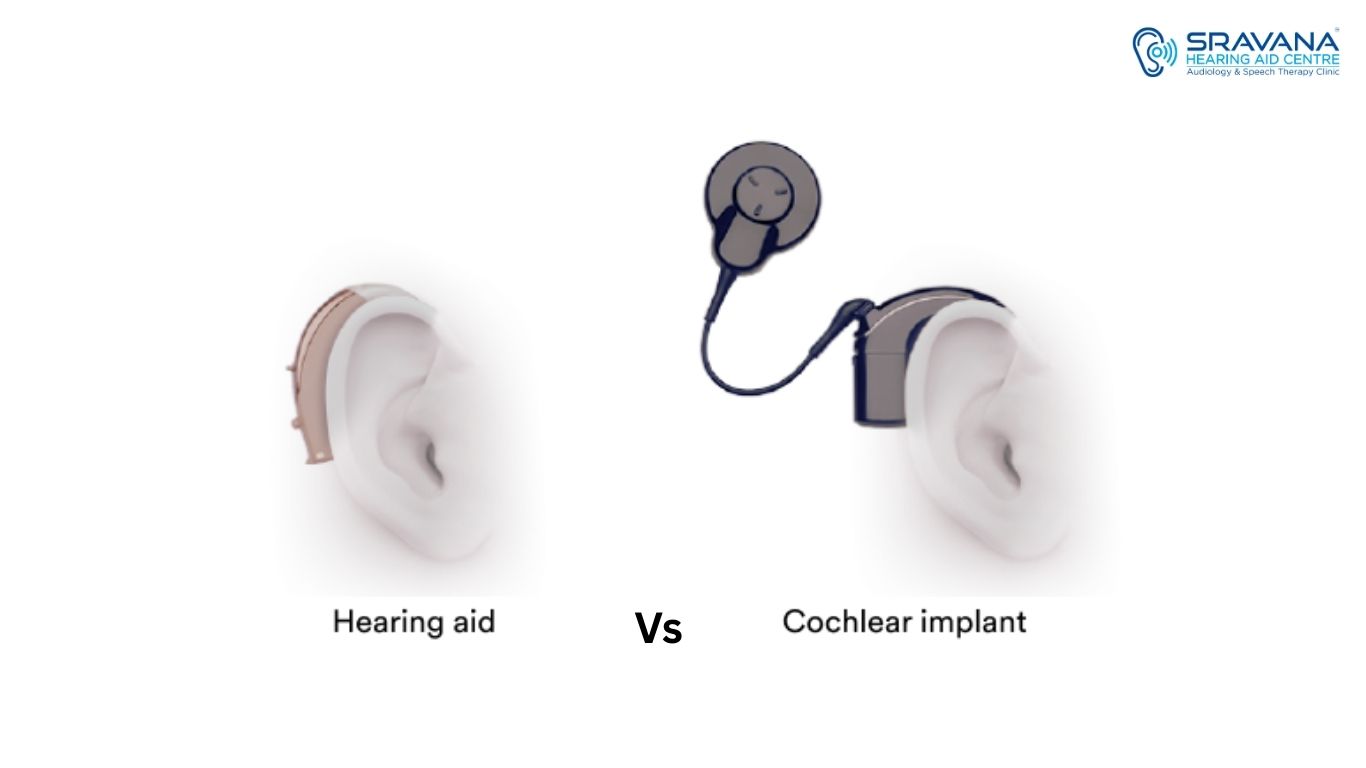
Mechanism: It uses bone conduction. A small titanium implant is placed in the bone behind the ear. An external sound processor captures sound and converts it into vibrations. These vibrations travel through the bones in your skull directly to the healthy inner ear, bypassing the damaged ear canal or middle ear entirely.
Cochlear Implant (CI)
A Cochlear Implant is more complex. It is designed for people whose inner ear (the cochlea) is severely damaged or non-functional.
- The Mechanism: It uses electrical stimulation. It bypasses the damaged parts of the ear entirely. An external processor captures sound and turns it into digital signals. These signals are sent to an internal electrode array placed inside the cochlea, which directly stimulates the auditory nerve. The brain then interprets these electrical pulses as sound.
2. Who is Eligible? (Candidacy Criteria)
Choosing between the two is not a matter of preference; This is a medical decision based on your specific type of hearing loss.
When BAHA is recommended:
Conductive hearing loss: When sound cannot reach the inner ear due to malformations (such as microtia or atresia) or chronic ear infections.
Single-Sided Deafness (SSD): If you are completely deaf in one ear but have good hearing in the other, the BHA can “transmit” sound through the bone from the bad side to the good side.
Mixed hearing loss: A combination of conductive and mild sensorineural loss.
When a Cochlear Implant is Recommended:
Severe to profound sensorineural deafness: Often called “nerve deafness”. It occurs when the hair cells in the cochlea become dead or damaged.
Limited usefulness of hearing aids: If you visit a hearing aid center and find that even the most powerful devices are not helping you understand speech, a CI is usually the next step.
3. The Surgical Procedure and Recovery in India
In the Indian medical context, both procedures are now highly standardized and safe, but the complexity varies.
BAHA Surgery
Nature: Generally considered a minor, minimally invasive surgery.
Anesthesia: Can often be performed under local anesthesia in adults.
Recovery: Patients usually go home the same day. It takes approx. 3 to 12 weeks before the bone fuses with the implant (osseointegration) before the processor can be attached.
cochlear implant surgery
Nature: A more complex surgical procedure that requires access to the inner ear.
Anesthesia: Always performed under general anesthesia.
Recovery: You may need to stay in the hospital for 1-2 days. “Turning on” or activation of the device usually occurs 2 to 4 weeks after surgery, when the surgical site has completely healed.
4. Sound Quality: Natural vs. Electronic
This is a common concern we hear at Sravana Hearing Aid Centre.
- BAHA Sound: Because it uses your own healthy cochlea, the sound is often described as quite natural. It’s simply your own hearing, just “delivered” through a different path.
- Cochlear Implant Sound: The sound is “synthetic” or “electronic.” New users often describe voices as sounding like “Mickey Mouse” or a “robotic” tone initially. However, the human brain is incredibly plastic. Over months of auditory training, the brain learns to interpret these signals, and most users eventually hear clear, meaningful speech.
5. Cost Considerations in India (2026)
Cost is an important factor for Indian families.
BAHA Cost: Generally less expensive. Depending on the brand (such as Cochlear or Med-L) and type of attachment (magnet vs. abutment), the cost can range from ₹ 2.5 lakh to ₹ 5 lakh.
Cochlear implant cost: High due to the complexity of the internal hardware and the need for intensive mapping after surgery. Prices in India usually range from ₹6 lakh to ₹15 lakh per penny.
Note: Many Indian states have government schemes (such as the ADIP scheme) that help provide free or subsidized cochlear implants to children from low-income backgrounds.
6. Maintenance and Lifestyle
Both units require a commitment to maintenance. You need to manage the batteries (rechargeable or zinc-air), keep the external processor dry (especially during the Indian monsoon!), and attend regular follow-up “mapping” sessions at your hearing aid center to fine-tune the sound.
Why Choose Sravana Hearing Aid Centre?
Navigating the world of transplants can be overwhelming. At Audible Hearing Aids, we don’t just sell devices; We provide lifetime support. Our expert audiologists conduct rigorous tests to determine which technology best suits your lifestyle. From initial diagnostic audiometry to rehabilitation after surgery and speech therapy, we are with you every step of the way.
Take the First Step Towards Better Hearing
Don’t let hearing loss limit your life or your child’s potential. Whether you need a sophisticated bone-conduction system or a cochlear implant, the experts at Sravana Hearing Aid Centre are here to guide you with compassion and technical excellence. We offer the latest technology and personalized care to ensure you never miss a moment of sound.
Contact Sravana Hearing Aid Centre today! Visit our contact us link to book a comprehensive hearing evaluation, or call us directly at 9449100200. Let’s rediscover the joy of sound together!
Frequently Asked Questions (FAQs)
- Is a Cochlear Implant better than a BAHA?
Neither is “better”—they serve different purposes. A BAHA is for those with middle ear issues but a healthy inner ear. A Cochlear Implant is for those with a damaged inner ear. Your audiologist will determine the right one based on your CT scans and hearing tests.
- Can I get a BAHA without surgery?
Yes! For children under 5 or those not ready for surgery, there is a “Softband” option. The processor is worn on an elastic headband that presses against the bone, allowing for hearing without any surgical intervention.
- Does insurance cover these implants in India?
Many private insurance providers in India have started covering cochlear implants and BAHAs, especially if they are deemed “medically necessary.” Additionally, several government employee schemes (like CGHS) provide coverage.
- Will I be able to hear music with a Cochlear Implant?
While speech clarity is the primary goal, many CI users enjoy music. It takes practice and “re-training” the brain, but modern implants have specialized programs to enhance the musical experience.
- Are there any risks with the surgery?
As with any surgery, there are minor risks of infection or inflammation at the site. Cochlear implants carry a very slight risk of affecting the facial nerve, which is why choosing an experienced ENT surgeon is crucial.
- Do I need to visit the hearing aid center after surgery?
Yes, absolutely. For both devices, but especially for Cochlear Implants, “mapping” (tuning) is essential. You will likely visit your audiologist several times in the first year to ensure the sound levels are comfortable and clear.